What is a nano influencer?
A nano influencer is a creator with a small but engaged audience, usually around 1,000 to 10,000 followers, who influences decisions through trust, relatability, and close community connections.
A nano influencer is a small creator, usually with 1,000 to 10,000 followers, who influences a close community through trust, local relevance, and regular audience interaction. In India, nano influencers are useful for local campaigns, campus outreach, product seeding, UGC, regional content, and startup testing.
A nano influencer is a content creator with small number of followers. A nano-influencer usually has around 1,000 to 10,000 followers. EY’s India influencer report lists nano influencers as creators with 100 to 10,000 followers. They have estimated around 500K+ nano influencers currently present in India. They also mentioned that nano influencers have the highest engagement rate among different creator tiers.
Nano influencers are often ignored for product promotion because their follower count looks small.
And that is a usual mistake.
Sometimes, nano-Influencers can be more useful to local business when compared to a larger creators. Businesses like D2C startups, cafés, salons, gyms, small fashion labels, education brands, and community-led products.
They may not give mass reach for the campaign.
But they can provide local trust, real conversations, low-cost testing, and honest creator-style content.
For aspiring creators, becoming a nano influencer is the first real step. It starts from posting casually to building an audience that brands can understand.
For viewers, nano influencers often feel closer and real. Their recommendations may feel like a genuine advice from someone from the same city, college, building, community, or niche.
This guide helps:
Reader | What This Article Helps Them Decide |
|---|---|
Brands | Whether nano influencers are right for a campaign |
Startups | How to test influencer marketing without large spend |
Creators | How to move from early posting to brand-ready content |
Aspiring creators | How to become a nano influencer from zero |
Viewers | How to understand why small creators influence buying decisions |
Researchers | How nano influencers fit inside the creator economy |
Agencies | How to manage local, campus, and niche campaigns |
A nano influencer is a content creator with a small follower base. The common followers range is between 1,000 to 10,000.
But these followers ranges may vary. EY’s India report uses 100 to 10,000 followers for nano influencers. It is useful in India because small creators in local communities can still influence purchase decisions.
A nano influencer can be:
A college student with strong campus reach
A food creator reviewing cafés in Indore
A fashion creator posting budget outfit ideas
A parenting creator in a WhatsApp-heavy local community
A fitness coach with 3,000 active followers
A skincare beginner sharing honest product routines
A local photographer known in a small city
A tuition teacher posting study tips on Instagram or YouTube
The key point is very simple:
Nano influence is built on closeness, not popularity.
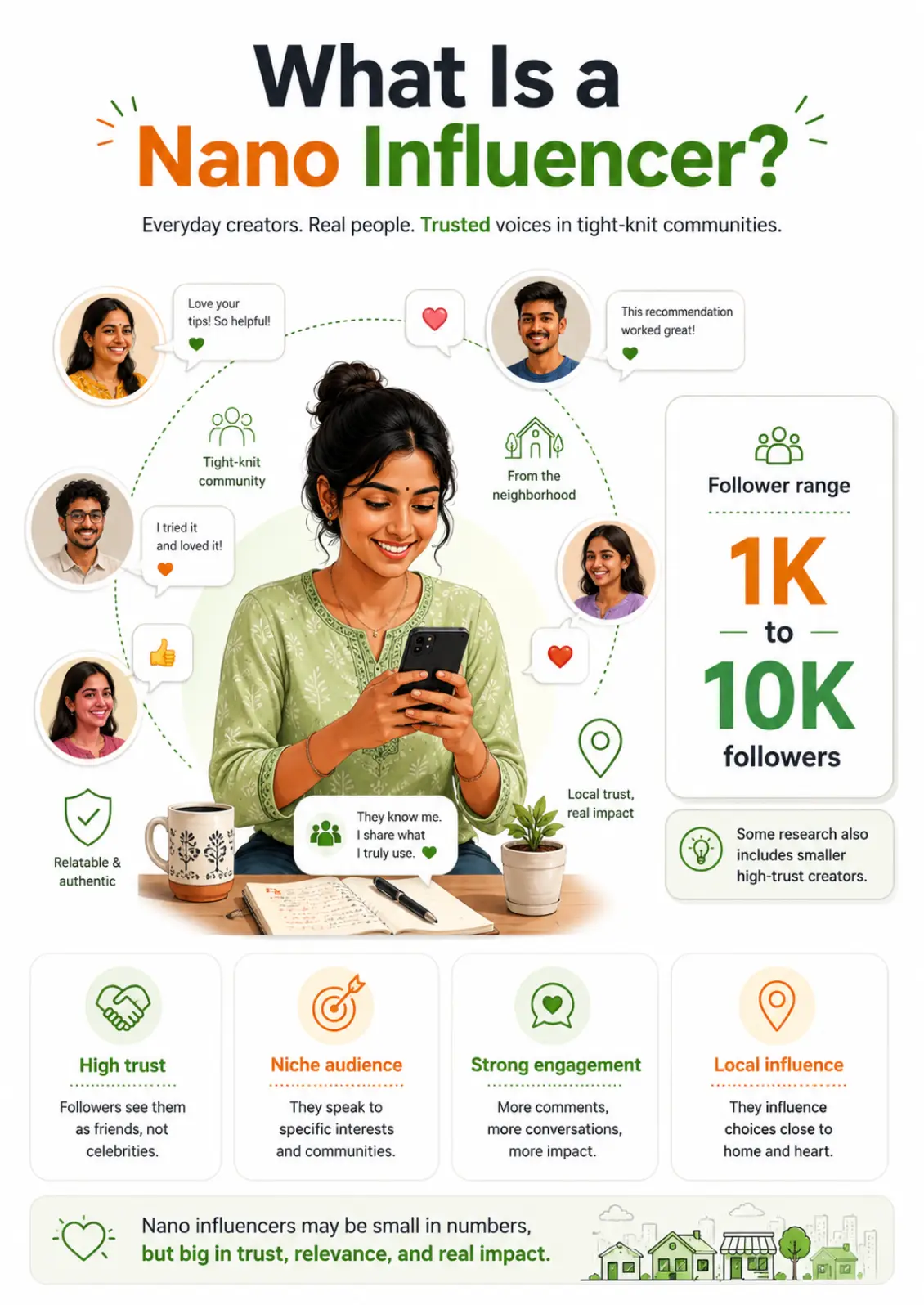
A nano influencer is not just a “small influencer.” The better way to understand nano influence is this: a small creator can affect decisions inside a specific circle because the audience feels close to them.
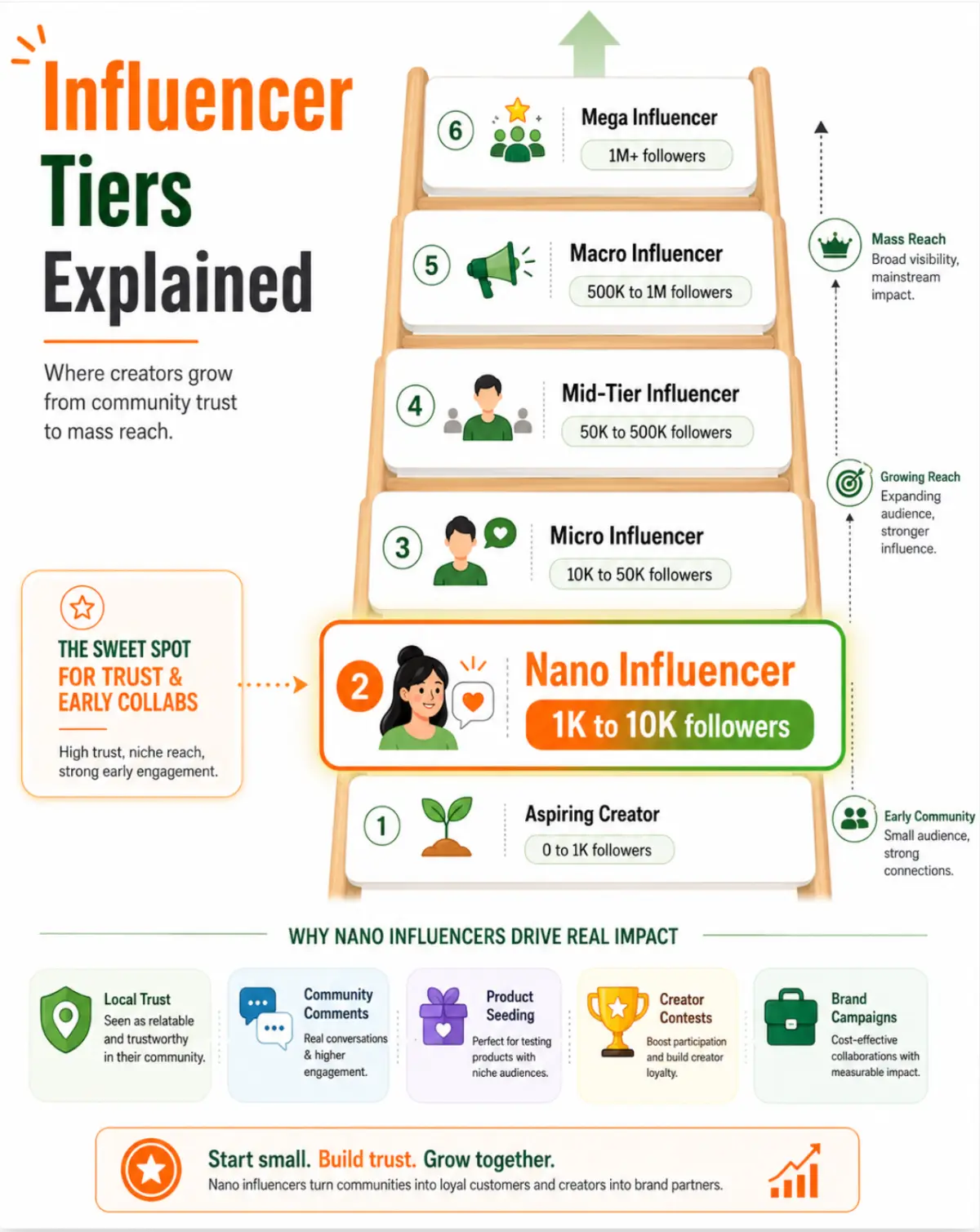
Nano influencers sit near the beginning of the creator ladder.
Creator Type | Common Follower Range | Main Strength | Best Brand Use |
|---|---|---|---|
Aspiring creator | 0 to 1,000 | Learning and testing | Content practice |
Nano influencer | 1,000 to 10,000 | Local trust and close community | Product seeding, local campaigns, campus campaigns |
Micro influencer | 10,000 to 100,000 | Niche trust and stronger reach | UGC, paid campaigns, product education |
Mid-tier influencer | 50,000 to 500,000 | Better reach with some relatability | Series campaigns, ambassador programs |
Macro influencer | 100,000 to 1 million | Wide awareness | Launches, large reach campaigns |
Mega influencer | 1 million+ | Mass visibility | National or global brand awareness |
EY’s India report categorizes mega influencers as 1M+ followers. Macro influencers as 100K to 1M followers. Micro influencers as 10K to 100K followers, and nano influencers as 100 to 10K followers. The report also states that micro and nano influencers are very useful for engagement. While mega and macro influencers help with awareness and brand loyalty.
India is not one audience, its scale is massive. India has the largest population with complex mix of culture, caste, region and belief which effects buying decision.
A brand selling in Jaipur, Kochi, Delhi NCR, Guwahati, Lucknow, Pune, or Dehradun may need different creator voices.
Nano influencers matter because they can reach communities that large creators may not understand.
India’s creator economy is not only about celebrity creators. BCG’s 2025 India creator economy report says India has over 2 to 2.5 million monetised creators influencing more than $350 to $400 billion in consumer spending. The report also projects creator-influenced consumption to cross $1 trillion by 2030.
This matters because brands cannot depend only on mega creators. They also need smaller creators who can speak to local, regional, student, niche, and community-led audiences.
India Reality | Why Nano Influencers Help |
|---|---|
Local trust matters | People often trust creators from their own city, college, or community |
Regional language matters | Hindi, Hinglish, Tamil, Bengali, Marathi, Telugu, Kannada, Malayalam, and Punjabi content can improve relatability |
Tier 2 and Tier 3 creators are growing | Smaller cities have creators with strong local attention |
Startup budgets are tight | Nano campaigns can test product response before large creator spending |
Student creators are active | Campus creators can support events, apps, fashion, food, education, and youth campaigns |
UGC needs real faces | Nano creators often create raw, relatable product videos |
BCG’s India creator economy report states that India has 2 to 2.5 million monetised creators. Who influence $350 to $400 billion in consumer spending. The creator-influenced consumption projected to cross $1 trillion by 2030.
That is the reason why brands need to understand all creator tiers, not only celebrity creators.
Nano influencers are useful when the goal is trust, testing, local reach, or content variety.
Use nano influencers when:
You want feedback before a larger launch.
The campaign is city-specific.
The product needs real usage videos.
You want campus participation.
You want product seeding.
You need regional content.
You want to test 20 small creators instead of 1 large creator.
You want community comments and DMs, not only views.
They are useful for feedback, city-specific campaigns, product seeding, regional content, and community comments.Best nano influencer campaign examples
Brand Type | Nano Influencer Campaign Idea | Why It Works |
|---|---|---|
Local café | 10 local food creators review menu items | Local discovery |
College festival | Student creators run campus reels | Peer trust |
Fitness studio | Members share 30-day progress videos | Real proof |
Skincare brand | Product seeding to nano beauty creators | Honest trials |
Bookstore | Local readers share book picks | Community relevance |
Edtech app | Student creators explain study hacks | Youth reach |
Boutique fashion brand | Styling videos by city creators | Local fashion appeal |
Travel homestay | Weekend stay videos by local creators | Regional trust |
Brands planning local creator campaigns can explore Cloutaura’s brand campaign workflow
Every brand has a different marketing requirement as per their product offering. Nano influencer marketing may not be the right choice for everyone.
Should Your Brand Work With Nano Influencers?
Use this simple decision check before planning a nano influencer campaign. Nano creators work best when the campaign needs trust, local relevance, product testing, or real creator content. They are not the right choice when the brand only wants instant national reach.
It can fail when:
Problem | What Happens | Fix |
|---|---|---|
No clear goal | The brand cannot judge success | Define awareness, UGC, sales, leads, or feedback |
Wrong creator fit | Followers do not match the buyer | Check city, language, niche, and audience |
No brief | Creator posts unclear content | Share product details, do’s, don’ts, and claim rules |
No tracking | Results become guesswork | Use UTM links, coupon codes, or creator reports |
Too many creators unmanaged | Campaign becomes chaotic | Use a tracker, platform, or structured workflow |
Gift-only confusion | Creator feels unpaid for fixed work | Define barter, paid terms, and usage rights early |
A nano influencer can help a brand enter a community. Nano-influencer cannot fix a weak product, broken offer, unclear landing page, or poor customer support.
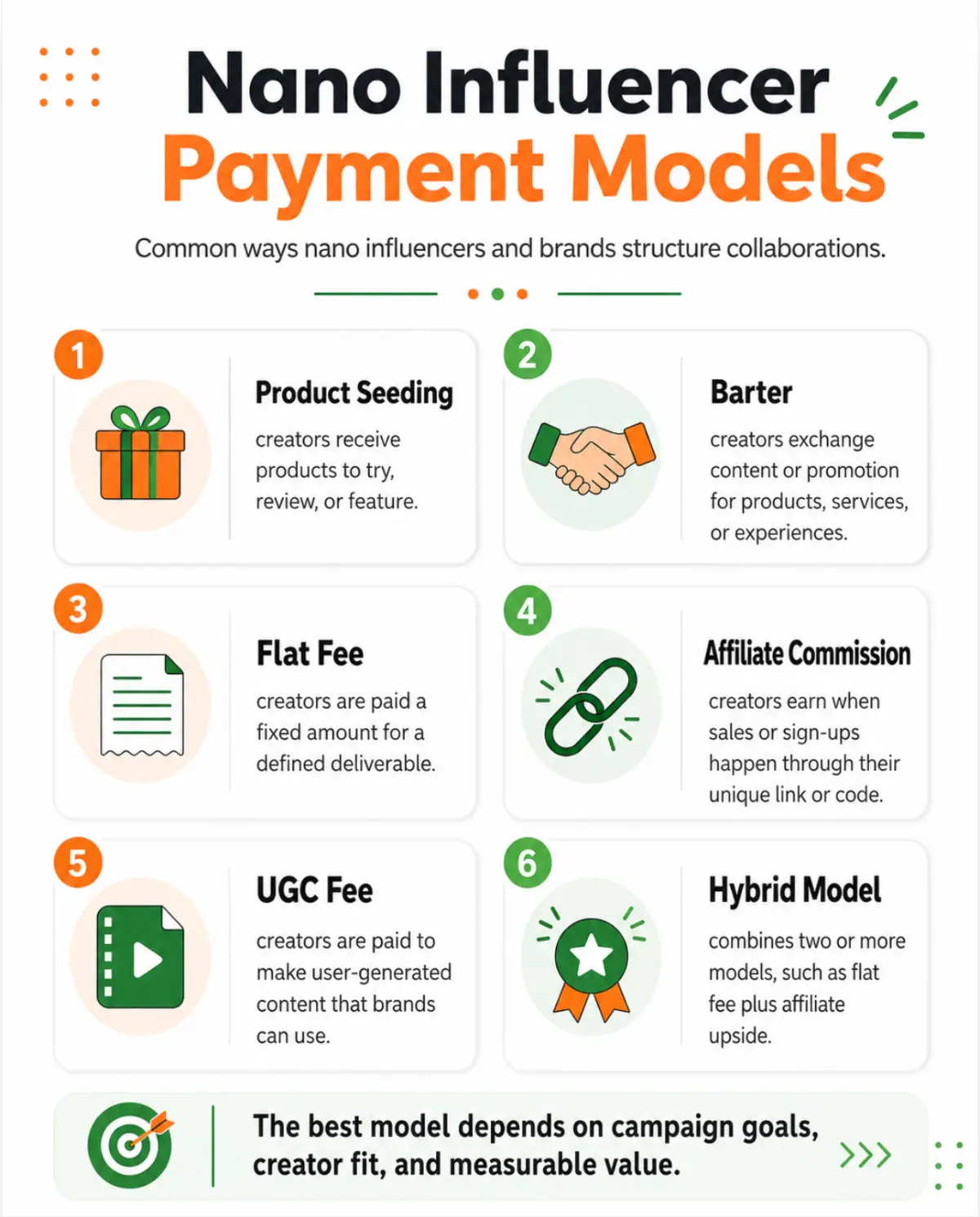
Nano influencer's pricing can depend on many factors. The follower count matters for any advertiser, but it is not the only factor. Brands and creators should consider:
Content format
Product value
Posting platform
Niche demand
Creator effort
Editing time
Usage rights
Exclusivity
Timeline
Affiliate potential
Whether the brand wants fixed deliverables
Whether paid ad reuse is included
Payment Model | Best Use Case | What to Clarify |
|---|---|---|
Free product | Early product seeding | Is posting required or optional? |
Barter plus bonus | Small campaign testing | What counts as a bonus trigger? |
Flat fee | Fixed Reel, Story, Short, or post | Deliverables, timeline, revisions |
Affiliate commission | E-commerce and D2C sales | Link, code, payout timeline |
UGC fee | Brand wants content asset | Usage rights and where content can be used |
Hybrid model | Content plus sales incentive | Base fee, commission, reporting |
Do not assume nano creators should always work for free. It is a misconception. If a brand wants a fixed script, deadline, revision rounds, usage rights, exclusivity, or paid ad reuse, the creator should discuss paid terms.
Brands can find nano influencers through:
Local hashtags
Instagram search
YouTube Shorts comments
College communities
Customer followers
City-specific pages
Creator contests
Referrals from micro creators
Influencer platforms
Cloutaura-style influencer marketing platform
Disclosure is not optional when there is a paid, gifted, affiliate, or other material connection between the brand and creator. Brands should explain disclosure expectations in the brief itself. Creators should not hide the brand relationship in vague captions or comments because it can reduce audience trust.
Check | Why It Matters |
|---|---|
City and locality | Local campaigns need local trust |
Language | Content must match audience comfort |
Comment quality | Real comments show community interest |
Posting consistency | Brand work needs reliability |
Past collaborations | Shows professionalism |
Content tone | Must fit brand safety |
Audience type | Avoid creator-buyer mismatch |
Disclosure comfort | Required for paid or material collaborations |
Usage rights | Prevents later content disputes |
ASCI says influencer advertisements must carry clear disclosure labels, and allowed labels include terms like “Ad,” “Sponsored,” “Collaboration,” “Partnership,” “Free gift,” “Affiliate,” and platform tags such as Instagram’s paid partnership tag.
The Department of Consumer Affairs also says disclosures must be prominently and clearly displayed when there is a material connection between the advertiser and influencer.
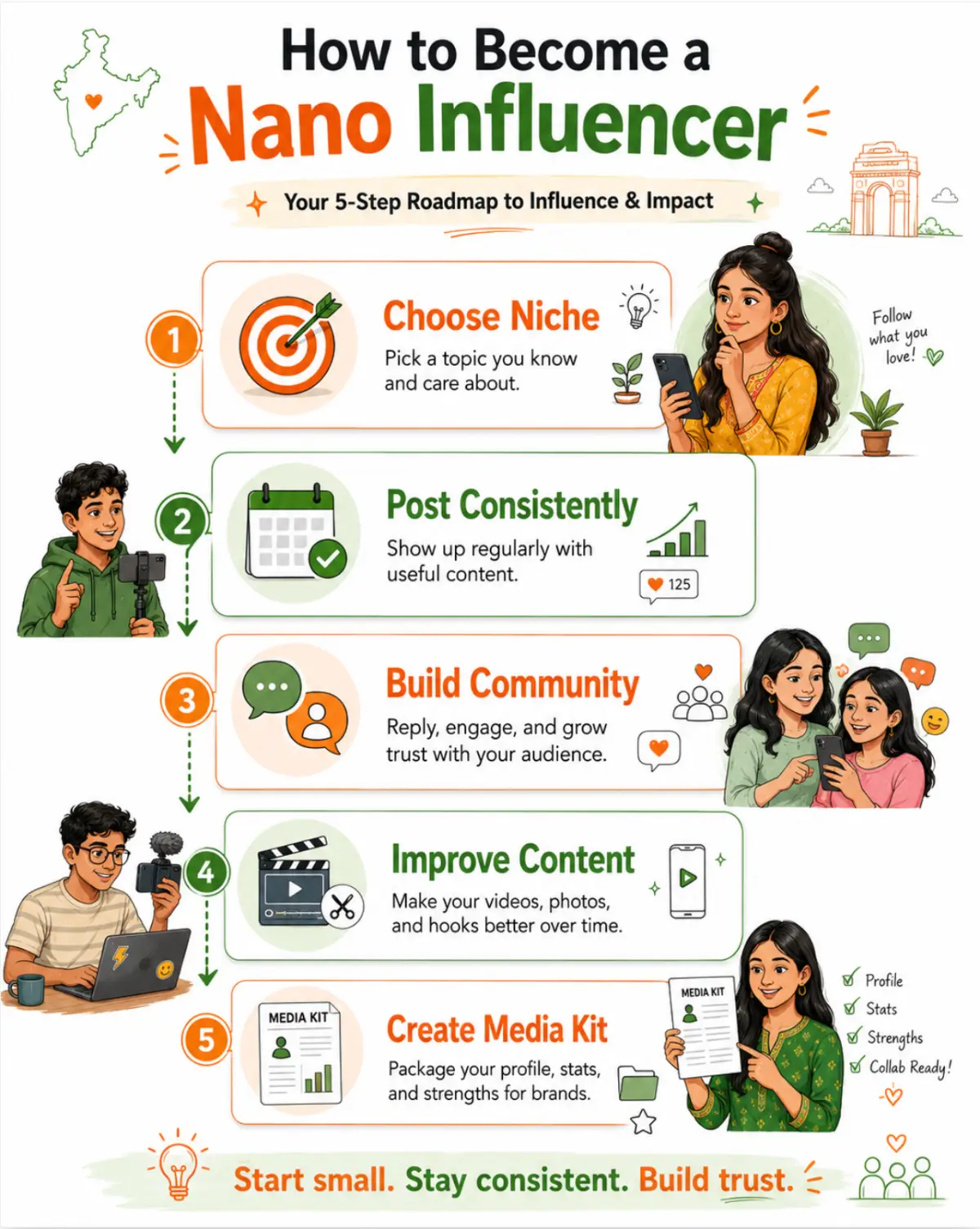
A person becomes a nano influencer by building trust in a small community. You must start with one topic or niche.
A good nano influencer niches to start include:
Budget fashion
Campus life
Food reviews
Study tips
Local travel
Fitness habits
Beauty trials
Skincare routines
Book reviews
Gaming clips
Personal finance basics
Career advice
Dog care
Local events
Regional comedy
Stage | Creator Focus | What to Build |
|---|---|---|
0 to 500 followers | Learn posting rhythm | 30 to 50 useful posts |
500 to 1,000 | Find topic-market fit | Repeatable content series |
1,000 to 3,000 | Build community | Reply to comments and DMs |
3,000 to 7,000 | Improve content quality | Better hooks, lighting, editing |
7,000 to 10,000 | Prepare for brand work | Media kit, rates, collaboration rules |
Creator name
City
Niche
Platform links
Audience screenshots
Best-performing posts
Content formats offered
Past collaborations
Rate options
Contact details
Disclosure policy
Usage rights note
Nano and micro influencers are both useful, but they solve different marketing problems.
Point | Nano Influencer | Micro Influencer |
|---|---|---|
Follower range | 1K to 10K | 10K to 100K |
Main value | Local trust | Niche reach |
Cost | Lower | Higher |
Best for | Product seeding, local campaigns, campus campaigns | UGC, paid campaigns, product education |
Content quality | Raw to semi-polished | Semi-polished to professional |
Brand management effort | Higher if many creators are used | Easier with fewer creators |
Engagement style | Personal comments and DMs | Broader but still niche |
As a simple reference, use nano influencers when you need community trust. Use micro influencer marketing when you need a stronger balance of trust and reach.
Many brands treat nano influencers like a cheap version of micro influencers. That is not the best way to work with them. Nano influencers work best when the campaign is designed for participation, feedback, local trust, and community content.
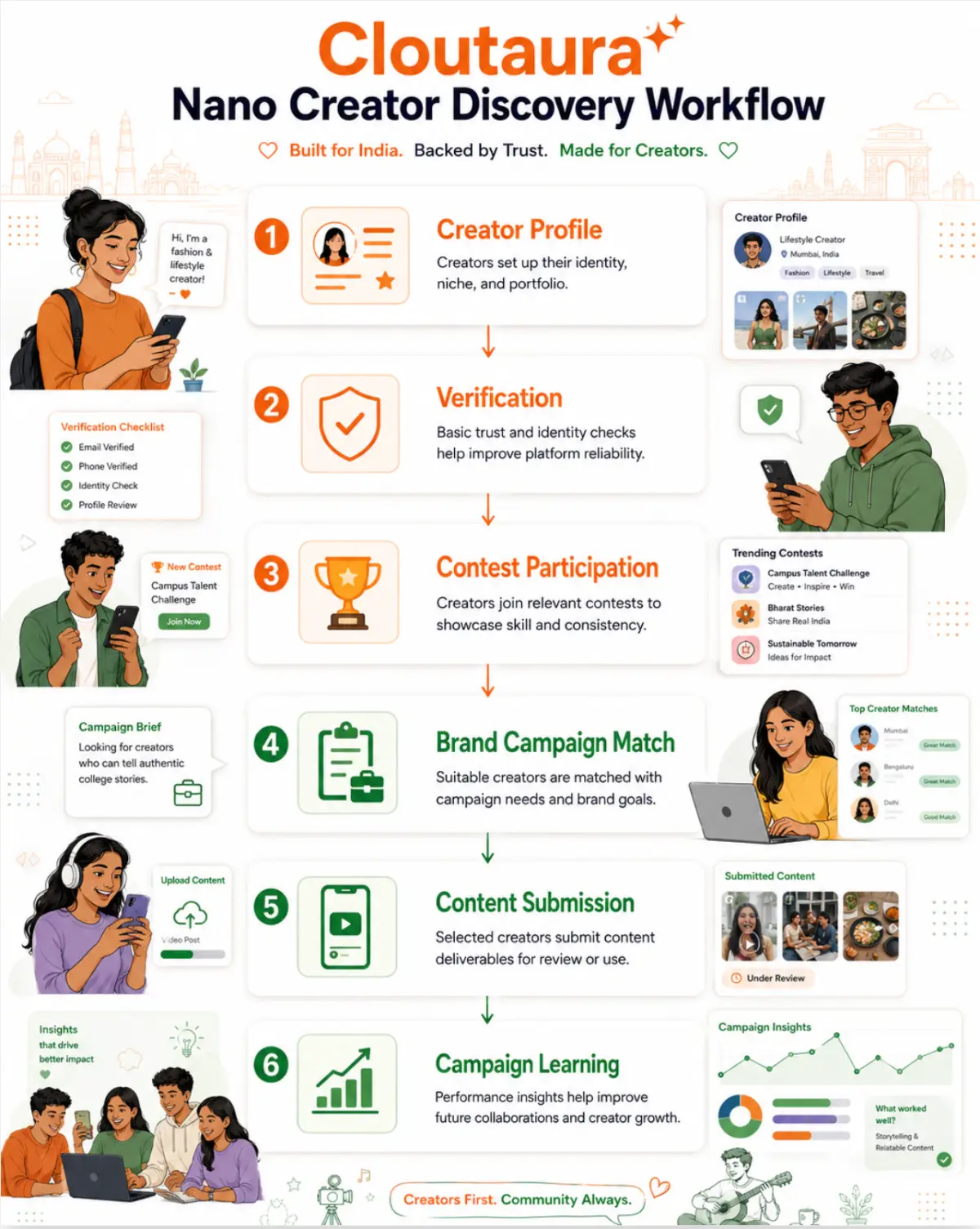
At Cloutaura, nano creators fit well into:
Creator contests
Student campaigns
City-based brand campaigns
Product seeding
Local discovery campaigns
Early creator recognition
UGC collection
Community voting and participation
From aviation operations, I learned that every small signal matters. A missed handover can create pressure later. A vague instruction can affect a full journey.
Influencer marketing campaigns work the similar way. Nano influencers may be small, but small does not mean weak. Many of them have audience trust inside real communities. Brands need to respect that trust.
For creators, the first brand deal should not feel confusing. The brief, payment, content rights, and timeline should be clear.
Cloutaura is being built with the belief that India’s next creator economy will not grow only from big names. It will grow when smaller creators get a fairer stage and brands get better ways to discover real trust.
Deepk Singh Rawat is Founder & CEO of Cloutaura, an India-first creator contest and creator-brand trust platform. With decades of experience across aviation, customer experience, event management, marketing, and digital transformation.
Cloutaura is being built for India’s creator economy as a creator contest, influencer marketing, live talent discovery, and creator-brand trust platform. Its tagline is The World is Your Stage & Fame is Your Skill.
For nano influencers, Cloutaura can help with visibility, contests, campaign participation, and a more structured way to show work.
For brands, it can help with creator discovery, creator verification, Clout Index, brand campaigns, creator contests, and clearer collaboration workflows.
This matters especially for Tier 2, Tier 3, and Tier 4 creators. Because many talented people do not have access to agency networks, physical auditions, or brand relationships. Cloutaura’s founder context directly identifies this access gap in India’s creator economy.
A nano influencer is a creator with a small but focused audience, usually around 1,000 to 10,000 followers. Some reports include creators below 1,000 if they have strong community trust. Nano influencers are useful for local campaigns, product seeding, campus outreach, UGC, and niche trust.
A nano influencer usually has 1,000 to 10,000 followers. EY’s India influencer report uses a broader range of 100 to 10,000 followers. The exact range can change by platform, but the main idea stays the same: nano influencers have small audiences with close community relationships.
Yes, 1,000 followers can be enough to start as a nano influencer if the creator has real engagement and a clear niche. A creator with 1,000 followers in a college, city, or topic community can influence attention, feedback, and buying decisions in a small but useful way.
Nano influencers can be useful for brands that want local trust, product trials, UGC, or low-cost testing. They are not ideal for mass awareness. A brand may need several nano creators to create enough reach, but the campaign can give useful learning and community signals.
Nano influencer payment depends on deliverables, content type, niche, usage rights, platform, and campaign goal. Some collaborations start with gifting, but fixed deliverables, deadlines, revisions, exclusivity, and paid ad reuse should usually involve clear paid terms or a hybrid payment model. If you are planning a nano creator campaign, start with clear deliverables, usage rights, and payment terms.
Brands can find nano influencers through local hashtags, Instagram search, creator platforms, student communities, customer followers, creator contests, city pages, referrals, and inbound applications. The best process checks city, language, content style, audience fit, engagement quality, and brand safety before outreach.
Choose one niche, post consistently, reply to comments, study what people save or share, and build a clear content style. Once your audience starts responding regularly, create a simple media kit with your niche, audience details, content samples, rates, and collaboration rules.
Good nano influencer niches include food, fashion, beauty, skincare, fitness, books, campus life, study tips, travel, gaming, pet care, parenting, career advice, local events, regional comedy, and personal finance basics. The best niche is one where the creator can post consistently and build trust.
Nano influencers are better for local trust, campus campaigns, small communities, and product seeding. Micro influencers are better when the brand needs wider niche reach and more polished campaign delivery. The better choice depends on the campaign goal, budget, audience, and content needs.
Nano influencers can accept free products when they want experience or genuinely like the product. But if a brand asks for fixed content, deadlines, revisions, exclusivity, or paid ad reuse, the creator should discuss payment. Free product alone may not cover the creator’s time and effort.
Brands should check audience fit, city, language, comment quality, content history, posting consistency, disclosure comfort, brand safety, usage rights, and payment expectations. Nano creators can be useful, but the campaign still needs a clear brief and a tracking plan.
Nano influencers can be useful for startups because they help test real audience response before the brand spends more money. They can support UGC, local awareness, community feedback, and early campaign learning. Startups should prepare a clear offer, landing page, tracking links, and payment terms first.
Ready to test nano influencers for a local, campus, or niche campaign?
Start with audience fit, clear creator terms, and simple tracking.
Next Step
Learn how Cloutaura is being built to support clearer creator discovery, creator contests, and brand-creator collaboration workflows in India.
Read Related GuidesFAQ
A nano influencer is a creator with a small but engaged audience, usually around 1,000 to 10,000 followers, who influences decisions through trust, relatability, and close community connections.
A nano influencer usually has between 1,000 and 10,000 followers, although some reports in India also include creators with as few as 100 followers if engagement and trust are strong.
Yes, 1,000 followers can be enough to be a nano influencer if the creator has real engagement, a clear niche, and an audience that trusts their recommendations and content.
Yes, nano influencers are worth it for brands that want local trust, community engagement, authentic user-generated content, and low-risk campaign testing before investing in larger influencer partnerships.
Nano influencers may be paid through free products, barter, flat fees, affiliate commissions, UGC fees, or hybrid models, depending on deliverables, usage rights, exclusivity, effort, and campaign goals.
Brands can find nano influencers through Instagram search, local hashtags, creator platforms, college communities, city pages, customer followers, referrals, creator contests, and structured influencer discovery workflows.
To become a nano influencer, choose a niche, post consistently, build trust through useful content, reply to comments, improve content quality, and create a simple media kit for brand outreach.
Good niches for nano influencers include food, fashion, skincare, beauty, fitness, campus life, study tips, travel, gaming, books, pet care, local events, and regional or community-based content.
Nano influencers are better for local trust, community engagement, and product seeding, while micro influencers are usually better for broader niche reach, more scale, and more polished brand campaign execution.
Nano influencers can accept free products for testing or early collaborations, but if a brand requires fixed deliverables, revisions, exclusivity, or paid ad usage, clear paid terms should be discussed.
Brands should check niche relevance, audience fit, city, language, comment quality, posting consistency, brand safety, disclosure comfort, usage rights, and whether the creator matches campaign goals clearly.
Yes, nano influencers are useful for startups because they help test product-market response, generate relatable content, build early trust, collect feedback, and run campaigns without a very large budget.
Keep Reading