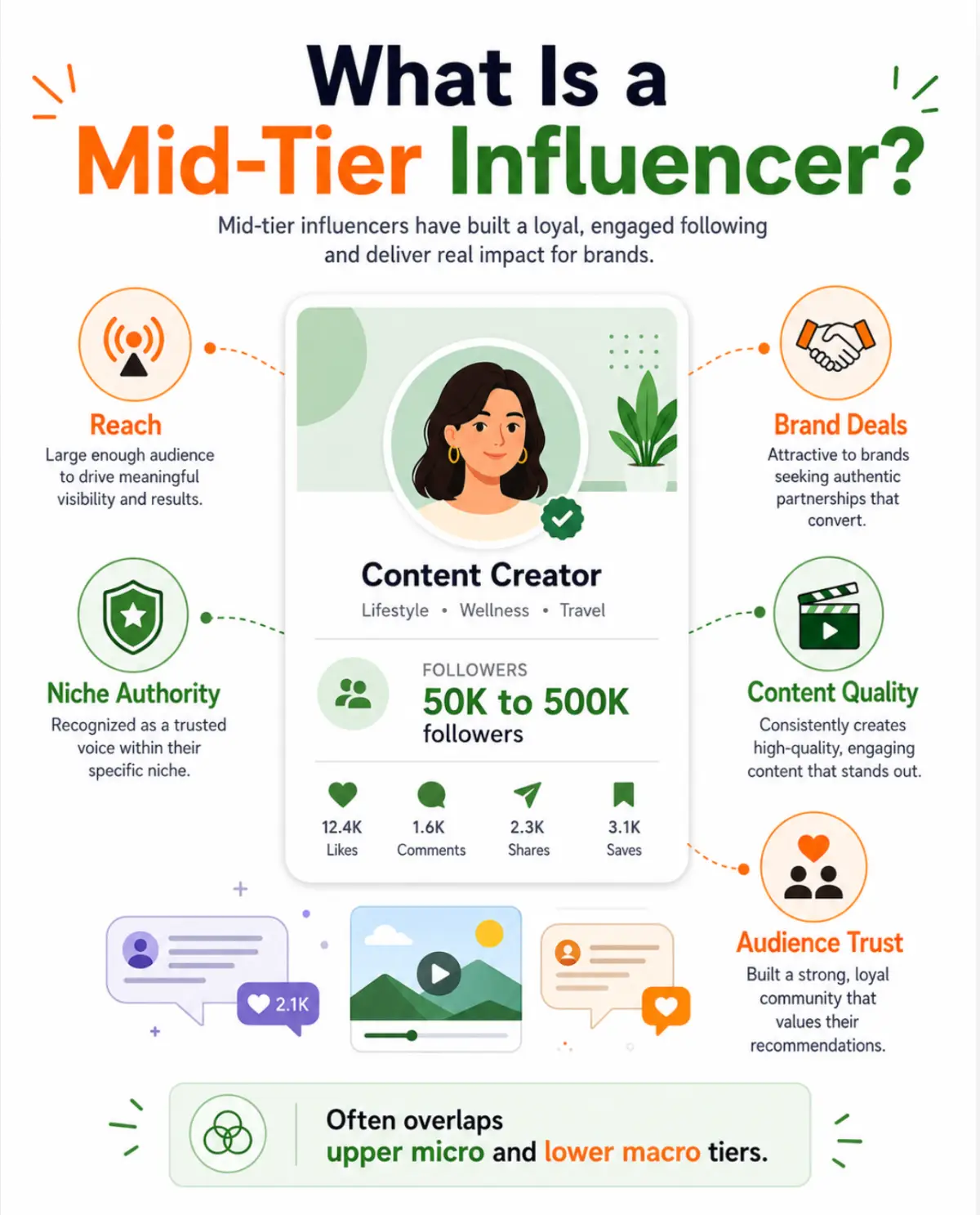
A mid-tier influencer is a creator who sits between micro and macro influencer. Many brands use 50,000 to 500,000 followers as a working range to identify them. But the category is less standardised than nano, micro, macro, and mega. In India, mid-tier creators are useful when brands need more reach than micro creators. But they are still looking for a stronger niche identity than celebrity campaigns.
Here is the simple truth
Mid-tier influencers are often misunderstood by people.
They are not beginners like nano influencers.
They are also not a full celebrity type content creators.
They sit somewhere in the middle. Where the creator has enough reach to support serious brand campaigns. But they may still have a clear niche, recognisable content style, and audience memory.
For brands, this tier can specifically be useful for:
New product launches.
Sponsored content series.
Brand ambassador programs.
Regional marketing campaigns.
Category education.
Trust-led audience reach.
UGC plus creator posting.
Long-term creator and brand partnerships.
For creators, reaching mid-tier status is where content creation feel like a serious business.
It is that stage where the creator may need to hire a manager. And, an editor, accountant, brand pitch process, contract discipline, and maintain a proper content calendar.
Who This Guide Helps
|
Brands | Whether to choose mid-tier influencers over micro, macro, or mega creators. |
Startups | Whether mid-tier creators fit the budget and campaign goal. |
Creators | How to move from micro to mid-tier influence. |
Aspiring creators | What professional systems are needed at this level. |
Viewers | Why some creators feel niche but still have large reach. |
Researchers | How mid-tier creators fit inside influencer tier analysis. |
Agencies | How to price, brief, track, and manage mid-tier campaigns. |
What Is a Mid-Tier Influencer?
A mid-tier influencer is a creator with a larger audience. Often larger than a micro influencer but less than a macro or mega influencer.
A common follower's range is considered between 50,000 to 500,000 followers
But remember: Mid-tier is a strategy label, not a universally fixed research category.
EY’s India report uses these categories: nano 100 to 10K, micro 10K to 100K, macro 100K to 1M, and mega 1M+. That means “mid-tier” often overlaps the upper micro and lower macro zones.
Mid-tier influencer examples by category
|
Fashion | A creator with 120K followers making outfit breakdowns. |
Fitness | A trainer with 85K followers and paid program credibility. |
Food | A city-based creator with 180K followers reviewing restaurants. |
Travel | A creator with 250K followers doing itinerary videos. |
Finance education | A YouTube creator explaining investing basics. |
B2B | A LinkedIn creator known in HR, SaaS, hiring, or marketing. |
Gaming | A streamer with loyal viewers and community recall. |
Education | A teacher creator with exam-focused content. |
Mid-Tier Influencer vs Nano, Micro, Macro, and Mega
|
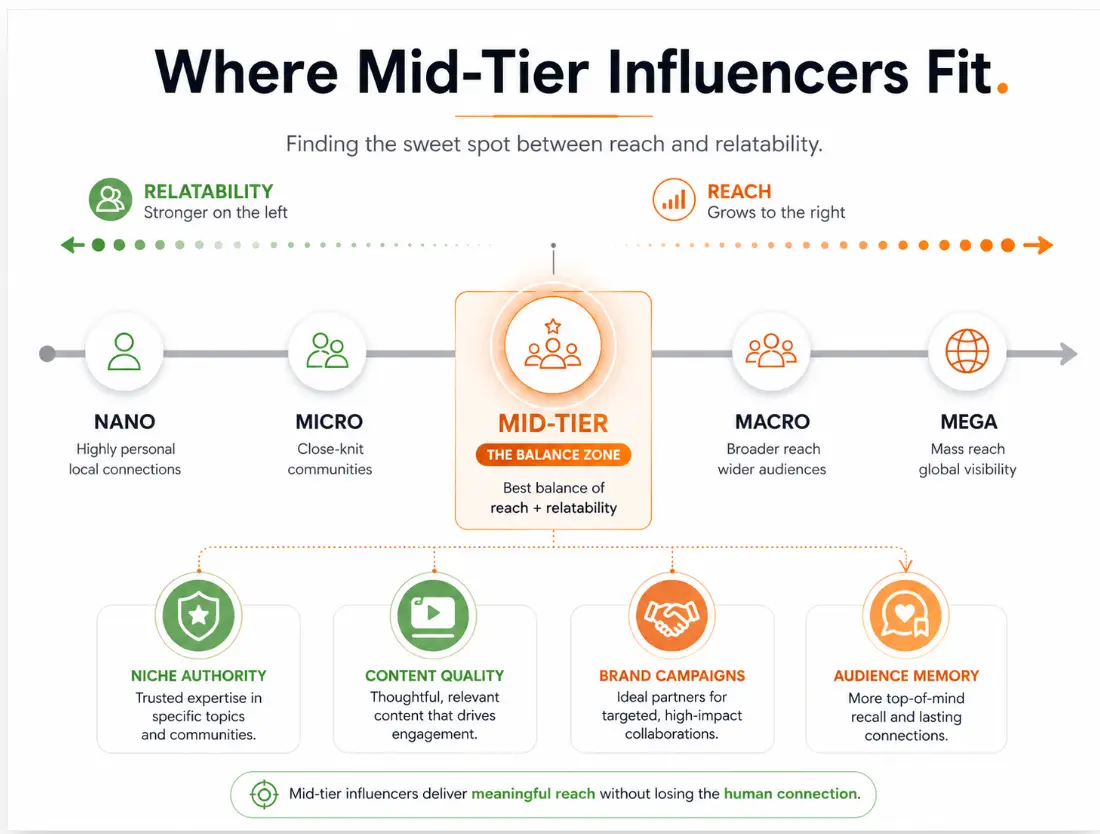
Nano Influencer | 1K to 10K | Local trust and product seeding | Low reach |
Micro Influencer | 10K to 100K | Niche trust and UGC | Limited scale |
Mid-tier Influencer | 50K to 500K | Reach plus niche memory | More expensive than micro |
Macro Influencer | 100K to 1M | Wider awareness | Less personal interaction |
Mega Influencer | 1M+ | Mass attention | High cost and lower intimacy |
Mid-tier creators are useful when a brand wants more scale but does not want to jump directly into macro or mega costs.
According to EY’s report "Brands should match influencer selection criteria to campaign objectives and that engagement rate plus target audience quality are top influencer selection criteria."
Influencer Tier Comparison
Why Brands Use Mid-Tier Influencers
Brands use mid-tier influencers when they need reach, but still want a creator with a defined audience.
Mid-tier influencers can help with:
Product launches
Brand recall
Sponsored series
Category education
Regional expansion
Long-form product explanation
App downloads
Event promotion
Festival campaigns
Ambassador partnerships
Best campaign uses
|
Launching a new product | Creator has enough reach to create awareness. |
Testing regional markets | Creator may have strong city or language relevance. |
Educating buyers | Creator can explain the category over multiple posts. |
Building recall | Audience sees repeated content over time. |
Getting UGC plus reach | Creator can produce usable content and publish it. |
Running contests | Creator can send traffic and participation. |
Brand ambassador program | Creator has enough identity to represent the brand. |
EY’s report says influencer marketing was part of three out of four brand strategies in its marketer survey and that Instagram and YouTube were the most preferred platforms for consuming influencer content.
When Mid-Tier Influencers Are the Wrong Choice
Mid-tier creators are not always the answer. They may be the wrong choice if:
|
The brand has no clear offer | Reach will not fix weak messaging |
The product page is not ready | Traffic may not convert |
The brief is vague | Creator content may miss the point |
The budget only covers one post | Repeated trust may be missing |
The creator’s audience is too broad | Campaign reach may not match buyers |
The brand wants guaranteed sales | Creator campaigns need tracking, not promises |
No usage rights are defined | Content reuse can create disputes |
A mid-tier influencer can support awareness and action. But the brand still needs a working customer journey.
Mid-Tier Influencer Pricing Logic
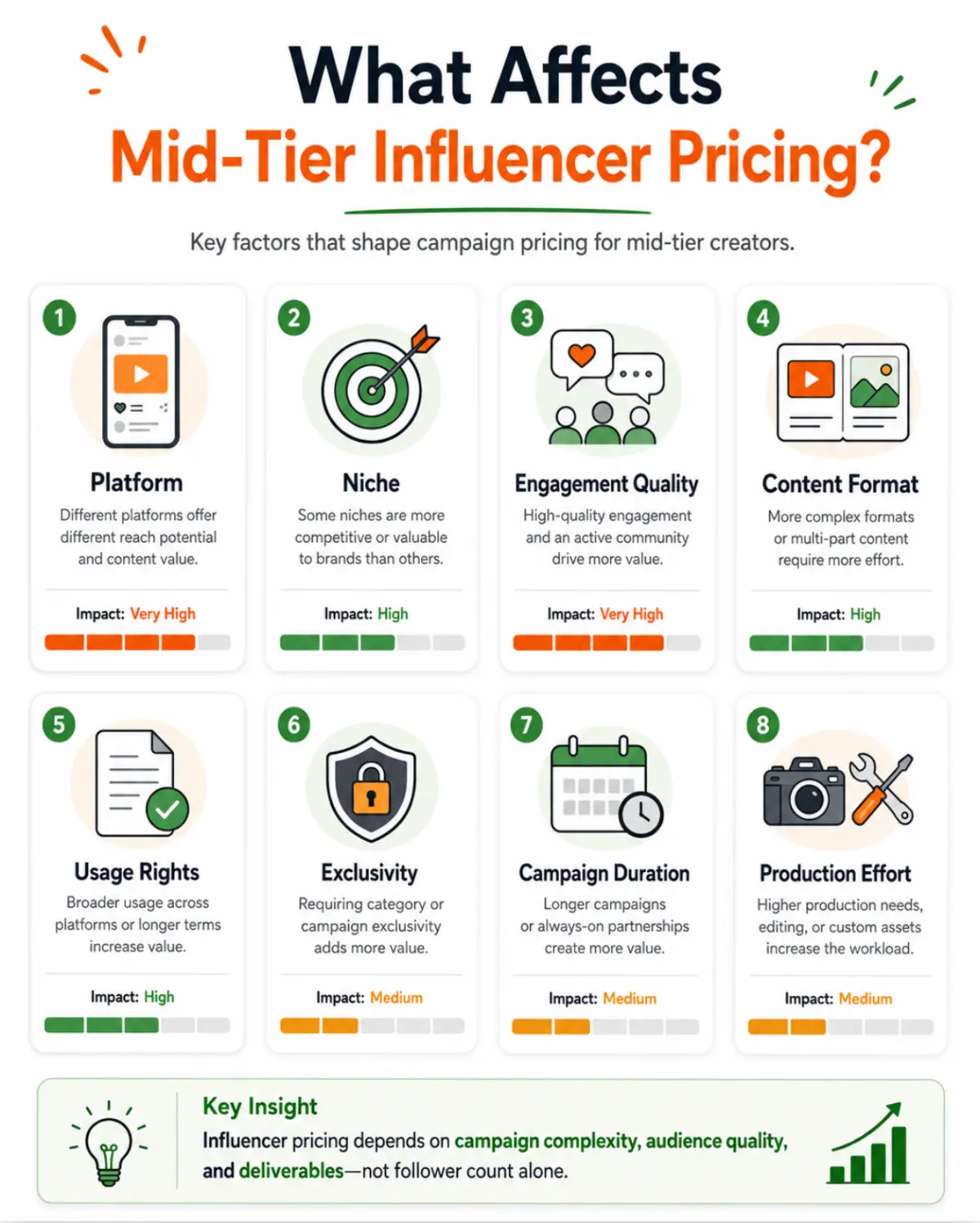
Mid-tier influencer pricing is usually higher than micro pricing. This is because the creator has more reach, better production, and stronger brand demand.
Their pricing depends on:
Do not price only by follower count.
A mid-tier finance educator may charge differently because of the audience value, content effort, and compliance risk are different.
Pricing model table
|
Flat fee | Fixed posts, Reels, Shorts, videos | Define edits, timeline, platform |
Series package | 3 to 6 posts over weeks | Needs content calendar |
Monthly retainer | Ambassador campaigns | Requires clear deliverables |
Affiliate plus fee | D2C and e-commerce | Needs reporting and payout terms |
Usage rights fee | Brand wants ads or website reuse | Define duration and channels |
Event fee | Hosting, appearances, launch events | Travel, timing, production needs |
Whitelisting / paid media use | Brand runs ads through creator content | Needs explicit written permission |
Mid-Tier Pricing Factors
How Brands Should Select Mid-Tier Influencers
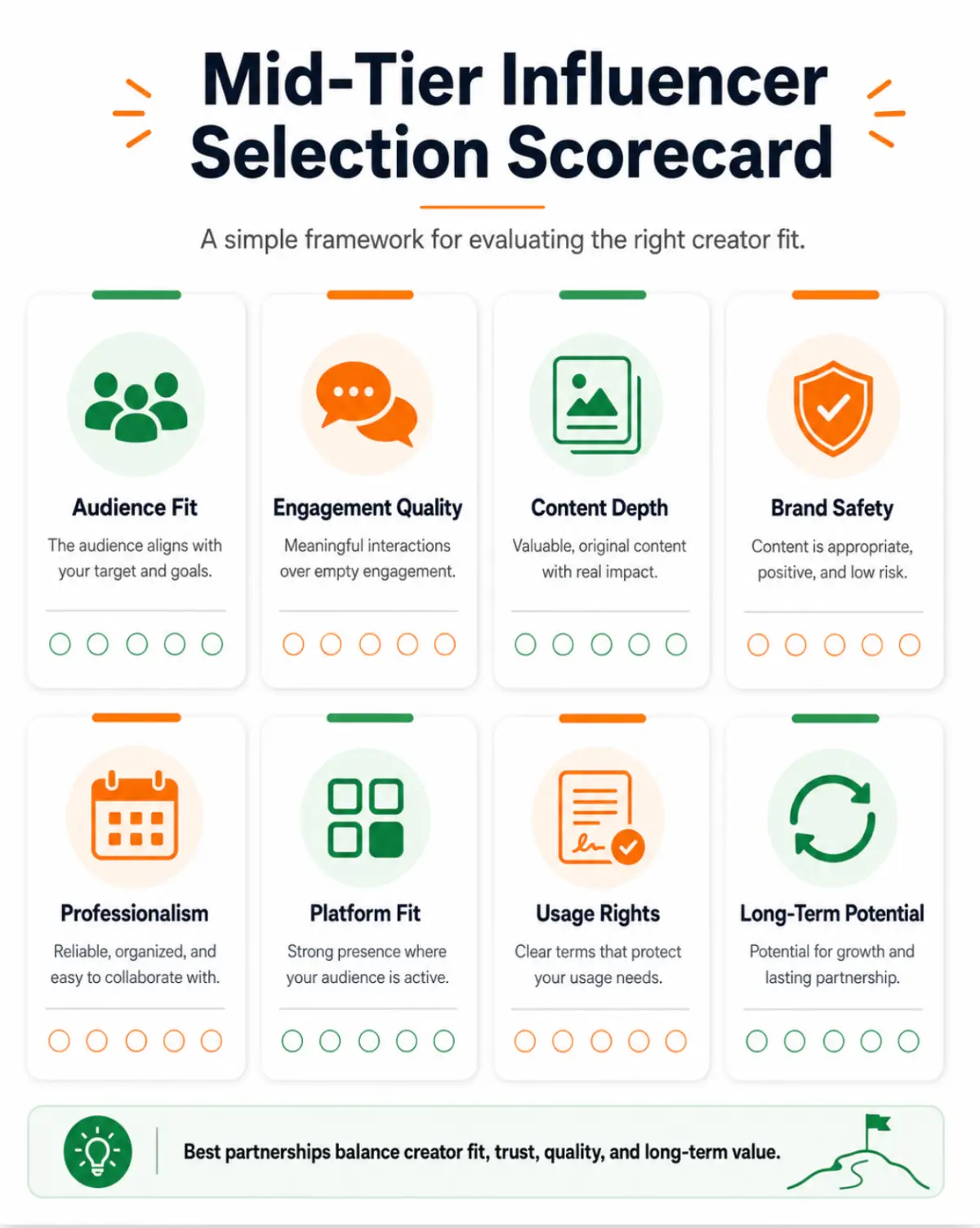
Mid-tier creator selection needs more discipline because the spend is higher than nano or micro campaigns.
Selection scorecard
|
Audience fit | City, language, age, niche, buyer match | Prevents wasted reach |
Engagement quality | Comments, saves, shares, DMs | Shows audience response |
Content depth | Can creator explain the product clearly? | Useful for education-led campaigns |
Brand safety | Past content, claims, controversy risk | Protects reputation |
Professionalism | Timelines, media kit, reporting, contracts | Reduces campaign stress |
Platform fit | Instagram, YouTube, LinkedIn, X, Facebook, Amazon | Matches buying journey |
Usage rights | Where can the brand reuse content? | Prevents legal confusion |
Long-term potential | Can the creator repeat content monthly? | Supports recall |
Mid-Tier Creator Scorecard
How Creators Grow Into Mid-Tier Influencers
A creator usually reaches mid-tier status by becoming more consistent, more useful, and more memorable.
Creator growth path
|
Nano | Build community | Consistency |
Micro | Create repeatable content | Media kit and basic pricing |
Mid-tier | Build category authority | Contracts, reporting, manager coordination |
Macro | Build media property | Team, brand strategy, cross-platform planning |
Mega | Build public identity | Long-term deals, PR, reputation management |
What creators should build before mid-tier
Clear niche
Repeatable content formats
Strong profile bio
Media kit
Rate card
Collaboration email
Usage rights policy
Disclosure comfort
Basic invoice system
Content calendar
Audience analytics folder
Brand safety habits
ASCI states that both advertisers and influencers share responsibility for disclosure when there is a material connection.
That means professional creators should understand disclosure before campaign volume increases.
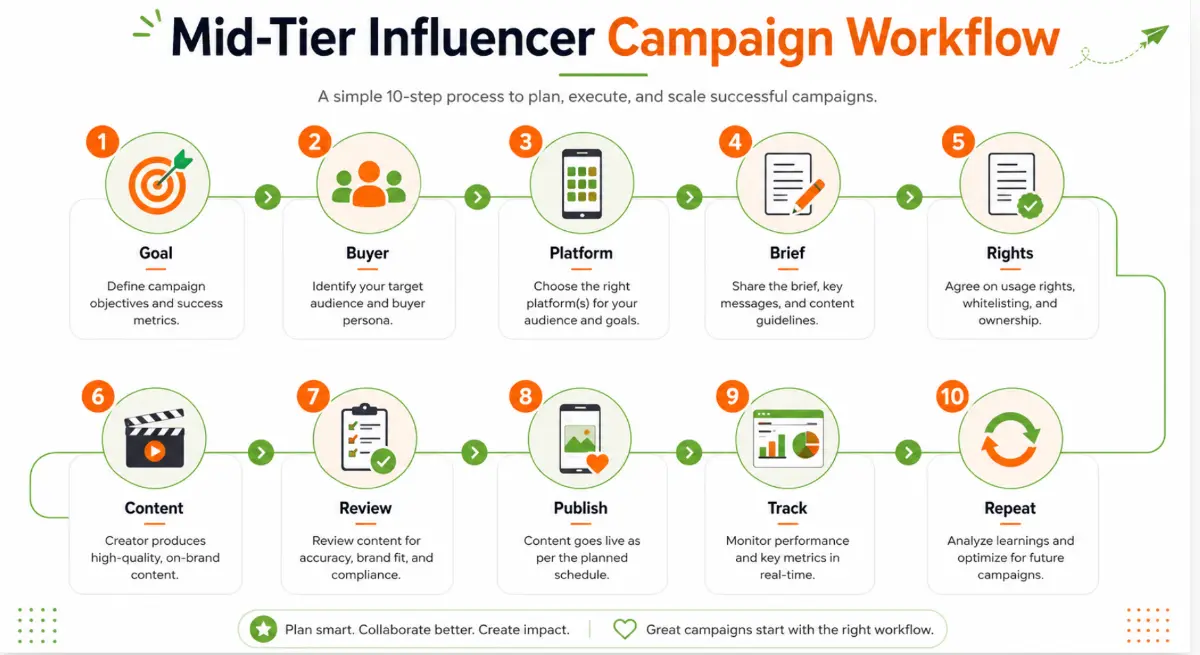
Mid-Tier Influencer Campaign Framework
|
1 | Define campaign goal | Confirm fit | Clear campaign purpose |
2 | Define buyer | Share audience data | Audience match |
3 | Choose platform | Recommend format | Platform plan |
4 | Write brief | Ask questions | Clear content direction |
5 | Agree rights | Confirm content use | Contract clarity |
6 | Create content | Keep natural style | Draft content |
7 | Review claims | Fix risky wording | Brand-safe content |
8 | Publish | Share links | Live campaign |
9 | Track results | Share analytics | Campaign report |
10 | Decide next step | Suggest learning | Repeat, scale, or stop |
Measurement framework
|
Awareness | Reach, views, impressions |
Trust | Saves, comments, watch time, DMs |
Consideration | Link clicks, profile visits, landing page views |
Sales | Coupon use, affiliate sales, purchases |
UGC | Usable content assets, hook tests, ad learnings |
Community | Poll votes, contest entries, shares |
Long-term value | Repeat creator performance, content reuse, audience sentiment |
Mid-Tier Campaign Workflow
Cloutaura Field Observation
Mid-tier influencers can look safer than smaller creators because they have more followers. But follower count can hide weak fit. A creator may have 200K followers and still be wrong for a product.
At Cloutaura, mid-tier creator selection should look at:
This helps brands avoid choosing creators only because they look popular.
Cloutaura’s content rules ask each blog to include practical frameworks, India-specific examples, founder-led insight, Cloutaura positioning, internal links, FAQs, CTA, and safety checks.
A Practical View from Cloutaura
Mid-tier creators remind me of a lesson from aviation operations: scale creates pressure.
When a team grows, informal systems stop working. You need clearer handovers, better documentation, faster review, and stronger accountability.
Creators face the same shift.
A nano or micro creator may manage everything alone. A mid-tier creator starts handling more brand requests, more audience expectations, and more content pressure.
Brands also need more discipline at this level. A vague brief can waste a serious campaign budget.
Cloutaura’s view is simple: trust should be built into the workflow before the campaign goes live.
Deepk Singh Rawat’s founder profile connects Cloutaura with fairness, transparency, creator recognition, and creator-brand trust in India’s creator economy.
How Cloutaura Helps
Cloutaura can help brands think beyond follower count when evaluating creators.
For mid-tier influencer campaigns, Cloutaura’s role can connect:
For creators, Cloutaura can support visibility and campaign access. For brands, it can support creator discovery and clearer evaluation signals.
This matters because many creator campaigns fail before content is posted. The issue is often weak fit, vague terms, unclear measurement, delayed approvals, or poor payment clarity.
FAQs
FAQ 1: What is a mid-tier influencer?
A mid-tier influencer is a creator who sits between micro and macro status. Many brands use 50,000 to 500,000 followers as a practical range, but the definition is not fixed. Mid-tier creators often have strong content quality, niche identity, and enough reach for serious brand campaigns.
FAQ 2: How many followers does a mid-tier influencer have?
A mid-tier influencer usually has 50,000 to 500,000 followers, depending on platform and agency definition. This category overlaps with upper micro and lower macro ranges. Brands should not rely only on follower count. Audience fit, engagement quality, content depth, and brand safety matter.
FAQ 3: Is 50K followers a mid-tier influencer?
Yes, 50K followers can place a creator near the mid-tier range, especially if the creator has a clear niche, strong engagement, and professional content. Some brands may still classify 50K as micro. The practical question is whether the creator can deliver reach, trust, and campaign quality.
FAQ 4: Are mid-tier influencers good for brands?
Mid-tier influencers can be useful when a brand wants more reach than micro creators but does not want to spend on macro or mega creators. They work well for product launches, sponsored series, brand ambassador programs, regional campaigns, and category education.
FAQ 5: How much do mid-tier influencers get paid?
Mid-tier influencer pay depends on platform, niche, follower count, content format, usage rights, exclusivity, production effort, campaign duration, and brand category. A mid-tier creator may charge flat fees, series packages, retainer fees, affiliate-plus-fee models, event fees, or content usage fees.
FAQ 6: How do brands choose mid-tier influencers?
Brands should check audience fit, engagement quality, content depth, brand safety, reliability, disclosure comfort, platform fit, and usage rights. A creator with many followers can still be a poor fit if their audience does not match the buyer or if their content tone creates brand risk.
FAQ 7: How can a creator become a mid-tier influencer?
A creator becomes mid-tier by building consistent content, clear niche authority, stronger audience recall, professional brand communication, and repeatable campaign performance. Creators should build a media kit, rate card, content calendar, invoice system, disclosure habits, and clear rules around usage rights.
Instagram, YouTube, LinkedIn, Facebook, X, newsletters, and podcasts can all work depending on the niche. Instagram and YouTube work well for visual and video-led content. LinkedIn works for B2B creators. Newsletters and podcasts work when trust and repeated attention matter.
FAQ 9: What is the difference between mid-tier and macro influencers?
Mid-tier influencers usually sit around 50K to 500K followers, while macro influencers often sit around 100K to 1M followers depending on the definition. Mid-tier creators often keep more niche identity, while macro creators usually provide wider awareness and larger campaign reach.
FAQ 10: Should startups work with mid-tier influencers?
Startups can work with mid-tier influencers when the offer, landing page, tracking, and budget are ready. If the startup is still testing product-market fit, nano or micro creators may be safer for learning. Mid-tier creators make more sense when the startup needs reach plus trust.
A mid-tier creator media kit should include niche, audience demographics, platform links, best posts, engagement screenshots, past collaborations, content formats, rates, usage rights, contact details, disclosure policy, and case-style results. Brands need this information to judge fit before spending.
FAQ 12: Are mid-tier influencers better than micro influencers?
Mid-tier influencers are better when a brand needs more reach and stronger production. Micro influencers may be better for lower-cost niche testing and community trust. The right choice depends on budget, campaign goal, audience size, platform, content needs, and tracking plan.
Ready to work with creators beyond follower count?
Start with fit, content quality, usage rights, and measurable outcomes.